


Introducing Joenja – the first targeted treatment for APDS
Click through the topics below for more information relating to Joenja, including clinical data and considerations for prescribers.

What is Joenja?
Joenja is the first and only disease-specific medicine that is designed to target the underlying immune defect in APDS, binding to the active site of the PI3Kδ enzyme.1–4 Joenja is selective for the delta isoform of PI3K, over the alpha, beta and gamma isoforms.3 Through this specificity Joenja attenuates its activity.1,3 This results in decreased PIP3 production and reduced downstream AKT signalling, reducing mTOR activity and restoring FOXO activity.1,3 This rebalances the survival, differentiation, proliferation, growth and migration of B and T cells, addressing the cause of the immune deficiency and immune dysregulation components of the disease.1–3


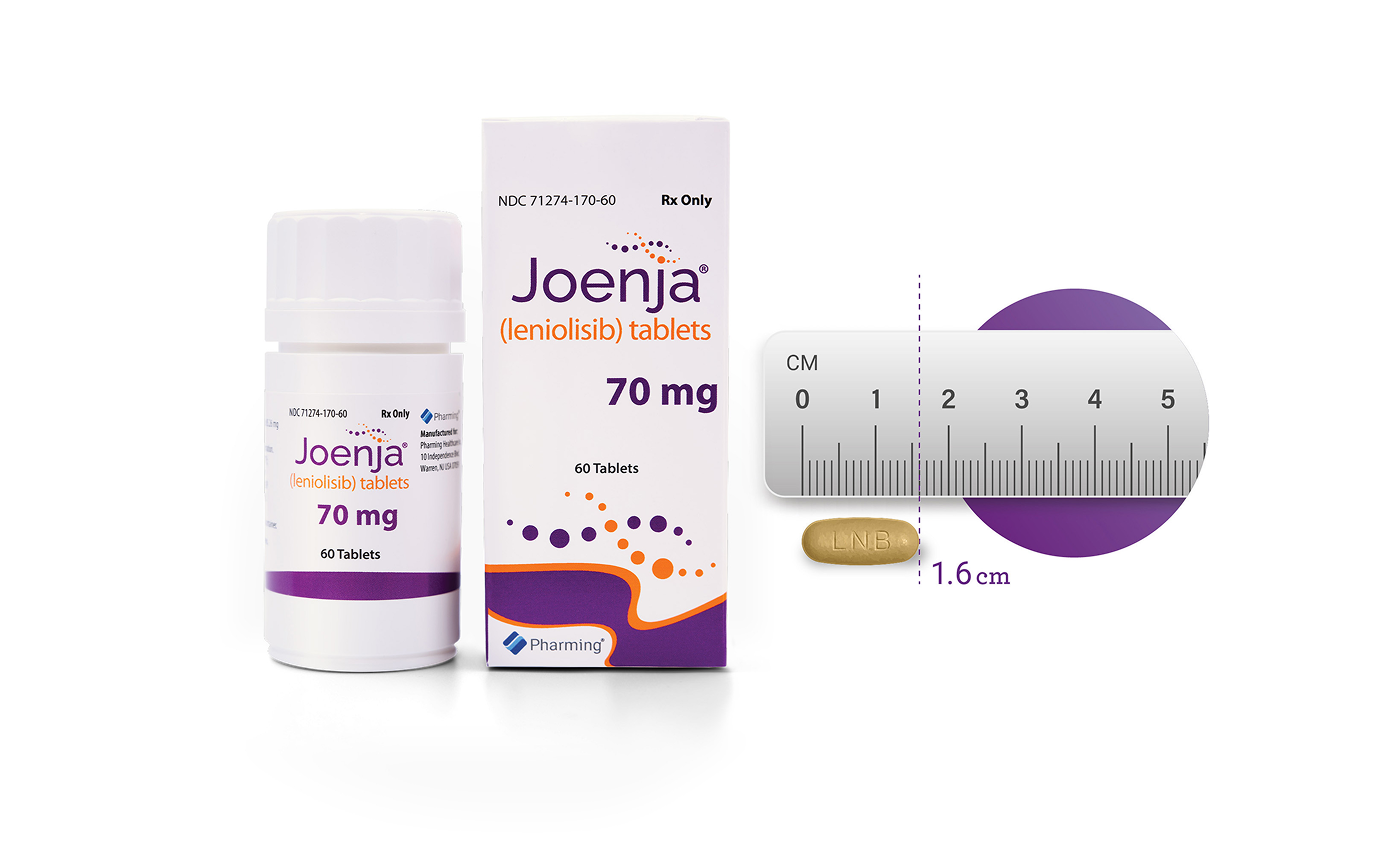
Joenja tablets are yellow and oval shaped. Each tablet contains 70 mg of leniolisib. Each pack contains 1 bottle with 60 Joenja tablets.
There is a growing body of evidence supporting the use of Joenja for the effective management of patients with APDS2,4,5
The efficacy and safety of Joenja have been investigated in multiple clinical trials, providing up to 5 years of data across Phase 2, Phase 3 and open-label extension studies. These trials provided data across a breadth of clinical endpoints, including 37 patients with APDS receiving Joenja for a median time of 102 weeks.2,5,6



Across the Phase 2, Phase 3 and open-label extension studies in adult and adolescent patients 12 year of age and older, compared with placebo, Joenja:2,5,6
- Demonstrated significant reductions in lymphadenopathy and a significant increase in naïve B cells
- Provided reductions in spleen volume
- Provided reductions in IgM levels for patients with high IgM at baseline
- Was generally well-tolerated
- Resulted in less than one in four patients experiencing TRAEs, no serious TRAEs and no discontinuations

Joenja also delivered numerical clinically meaningful improvements to patient-reported HRQoL across clinical trials, but this did not meet statistical significance.5–7
Across these trials patient experience on treatment was also studied – most patients explicitly attributed an improvement in APDS-related symptoms and HRQoL to treatment with Joenja, including improvements in work/school performance/attendance, with one in three patients attributing an improvement in overall wellbeing to treatment with Joenja.8

Joenja offers convenient oral dosing, which could reduce the treatment and infusion burden for your patients.1
- Twice-daily oral tablet, taken with or without food
- No special instructions before or after taking Joenja
Joenja clinical data
Joenja was investigated in a Phase 2 safety and tolerability dose-finding clinical trial, enrolling six patients aged 17–31 years with pathogenic variants of PIK3CD and clinical findings consistent with APDS. The primary endpoint was safety and pAKT as a marker of PI3Kδ pathway suppression. Following the trial, the 70 mg BD dose was selected as the dose for the Phase 3 study.2
Study design and baseline data
Joenja was investigated in a 12-week blinded, randomised, placebo-controlled, Phase 3 clinical trial, enrolling 31 patients aged 12–75 years with pathogenic variants of PIK3CD or PIK3R1, clinical findings consistent with APDS and ≥1 measurable nodal lesion on CT or MRI scan. The co-primary endpoints were improvement in lymphoproliferation and increase in the percentage of naïve B cells.5,9

Baseline demographics and disease characteristics were comparable between treatment arms – the majority of patients were white (Joenja, 86%; placebo, 70%), with a mean age of 22.2 and 26.7 years for the Joenja and placebo arms, respectively.1,5 For full details of these data, please refer to Rao VK, et al. Blood. 2023;141(9):971–983.
| Disease characteristics | Joenja (n=21) | Placebo (n=10) |
|---|---|---|
| IRT (concomitant IgG), n (%) | 14 (66.7) | 7 (70.0) |
| Previous rapamycin/sirolimus use, n (%) | 4 (19.0) | 3 (30.0) |
| Lymphoproliferation,* n (%) | 15 (71.4) | 7 (70.0) |
| Chronic infections, n (%) | 18 (85.7) | 7 (70.0) |
| Pulmonary disease, n (%) | 14 (66.7) | 8 (80.0) |
Efficacy
Co-primary endpoint: Joenja significantly increased the percentage of naïve B cells vs placebo at 12 weeks5

Least squares mean of the change from baseline at Day 85 in the percentage of naïve B cells (CD19+CD27-CD10-) out of total B CD19+ cells. Error bars are SEM.
*Two patients from each treatment arm were excluded due to protocol deviations and only participants with <48% naïve B cells at baseline were included in the primary analysis (n=13).5
Secondary endpoint: Joenja significantly reduced spleen size vs placebo at 12 weeks5

Individual spleen volumes (Joenja, n=20; placebo, n=9). The grey box indicates the reference range for adults. All participants from the safety analysis set with measurements are included.
A number of additional exploratory endpoints were assessed in the trial5
These included including liver size, B-cell populations, T-cell populations, serum immunoglobulin levels, cytokines, viral burden (EBV/CMV) and cytopenias.5 Data from exploratory endpoints are not powered for definitive conclusions and should be interpreted with caution. Details of the exploratory endpoints can be found in Rao VK, et al. Blood. 2023;141(9):971–983.
Safety
The majority of AEs reported were Grade 1 (74.2%) and no deaths were reported during or within 30 days of the end of the trial5

Study design
Joenja was investigated in an open-label extension, enrolling 37 patients previously participating in the Phase 2 clinical trial (n=6), Phase 3 clinical trial (n=29) as well as additional participants previously treated with other PI3Kδ inhibitors (n=2). The primary endpoint was safety, including reported AEs and data collected via routine physical examinations, vital signs, haematological parameters, blood chemistry and urinalysis.6,10

Safety
Joenja was generally well tolerated with long-term use7

Efficacy
Secondary endpoint: Overall infection rates decreased per additional year of Joenja therapy10

A number of additional exploratory endpoints were assessed in the trial6
These included serum IgM levels, use of anti-infective co-medications such as IRT and antibiotics, reduction of lymphoproliferation as assessed via changes in spleen volume and lymph node size, B- and T-cell immunophenotyping, cytokine and chemokine profiles, CMV and EBV viremia.6 Data from exploratory endpoints are not powered for definitive conclusions and should be interpreted with caution. Details of the exploratory endpoints can be found in Rao VK, et al. Blood Adv. 2024;8(12):3092–3108 and Rao VK, et al. Poster presented at the International Primary Immunodeficiencies congress, 5–7 November 2025, Prague, Czech Republic.
HRQoL reported in the open-label extension
In the open label extension, HRQoL was assessed through patient- and physician-reported outcomes as a secondary endpoint.6 Patients reported improved APDS-related wellbeing as demonstrated by an 8.5-point improvement from baseline to Day 728.[TBC] This change can be considered clinically meaningful in patients with primary immunodeficiencies (MCID: 7.0).[TBC] 70% of patients receiving Joenja had improvements in activity and energy levels (vs 44.4% receiving placebo), as well as showing clinically meaningful improvements in general health and physical and social functioning component.5–7
Although baseline symptoms/HRQoL were not available, most patients receiving Joenja attributed improvements in APDS-related symptoms and HRQoL specifically to their treatment, including improvements in work/school performance/attendance, with more than one in three patients attributing an improvement in overall wellbeing to treatment with Joenja.8